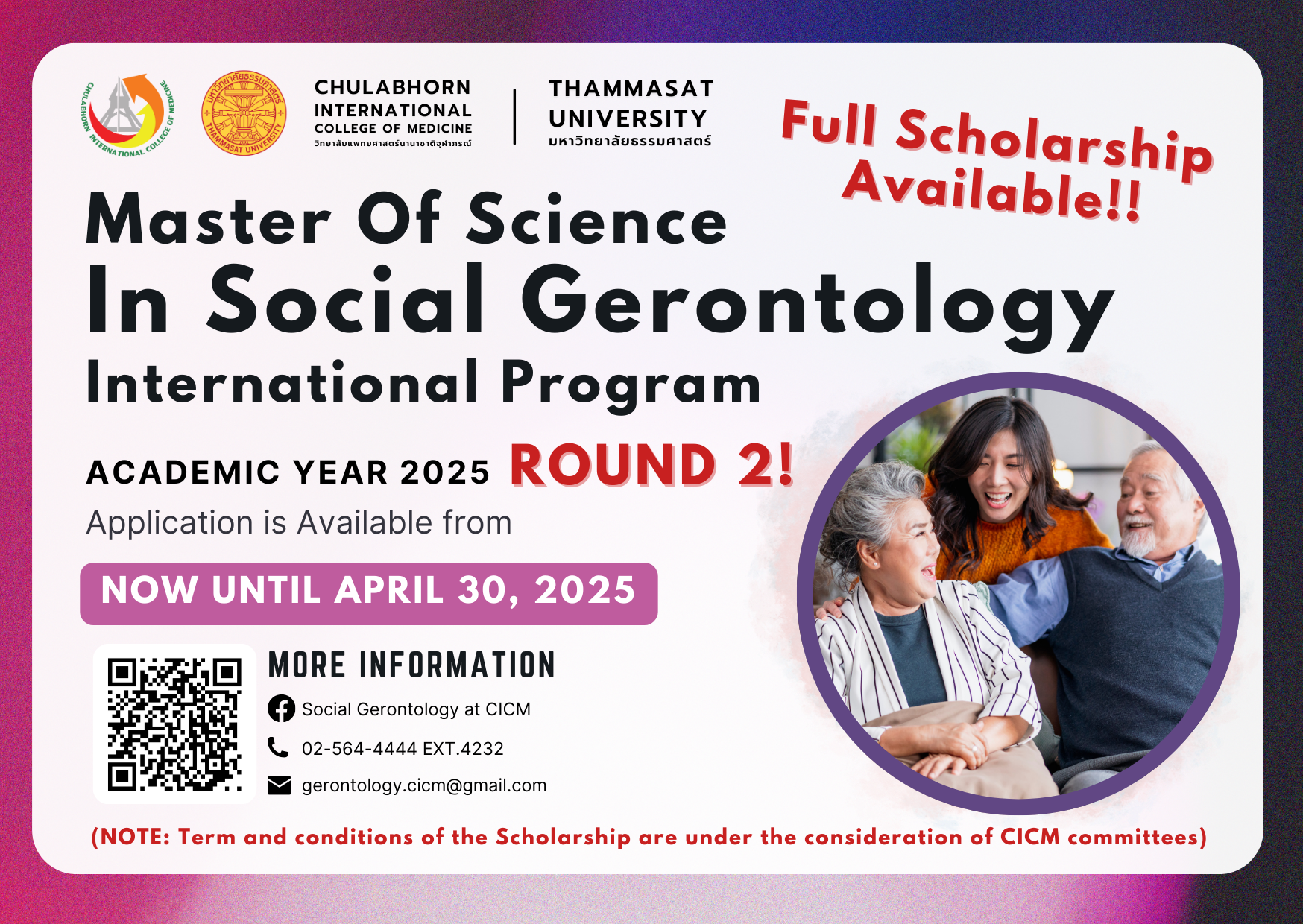
Announcement
Staff
Course Syllabus
| Plan A1: Research Focus | ||||||||||||||||||||||||||||||||||||||||
|
||||||||||||||||||||||||||||||||||||||||
| Plan A2: Course Work and Thesis | ||||||||||||||||||||||||||||||||||||||||
|
Requirements
General requirements
Master of Science Program in Social Gerontology |
| Thammasat University Students’ qualifications are detailed in the University Regulations for Graduate Students, 2553 B.E., and itemized No. 7. |
|
| - Applicant must possess Bachelor’s Degree in any fields from university approved by the University Council. |
| - At least two years of experience on elderly health and life development or research published in journals approved by the Office of Higher Education Commissions or in TCI database showing expertise with at least 50 percent research section per one article ought to be presented. |
| - Specific qualifications shall depend on the consideration of the program’s committee. |
| This is a research-focus program. Students need to complete the thesis work at least 36 credits. Additional course and academic activities may be applied according to the recommendation of the advisors or the program committee. |
|
| - Applicant must possess Bachelor’s Degree in any fields from university approved by the University Council. |
| - Specific qualifications shall depend on the consideration of the program’s committee. |
| Applicants who do not meet one of the stated requirements or give any false information or intentionally conceal any information, they shall be terminated for applying to the program although they can pass all entrance examinations. |
Specific requirements
English requirements
General knowledge score
Preferred Characteristics
1. Research-Oriented Mindset — ability to engage in scientific inquiry, data analysis, and critical reasoning in the field of social gerontology.
2. Humanistic Skills — compassion, empathy, and ethical sensitivity toward the elderly and vulnerable populations.
3. Cross-Cultural Mindset — openness to cultural diversity, inclusivity, and understanding of global aging contexts.
4. Active Learning Approach — enthusiasm for inquiry-based, participatory, and reflective learning experiences.
5. Self-Directed Learning Skills — capacity to set goals, manage time effectively, and pursue independent research.
6. Collaborative Leadership — ability to work effectively in multidisciplinary teams and lead community-based projects.
7. Moral Integrity and Professional Ethics — commitment to honesty, social responsibility, and research ethics.
8. Adaptability and Resilience — readiness to manage challenges and apply interdisciplinary knowledge in dynamic contexts.
9. Communication and Presentation Skills — competence in both academic writing and oral communication, especially in English.
10. Social Commitment — motivation to contribute to improving the quality of life and promoting well-being among older adults.
Supporting Documents for Program Admission
|
| Candidates must pass written and interview examinations. |
|
| Written Examination on Basic knowledge |
| Interview Examination |
| The decision of the committees is an end and it must be acceptable. |
Tuition and Fees
| Thai Students: | 65,000 THB/Semester |
| Foreign Students: | 85,000 THB/Semester |
| This amount does not include delayed registration fee, student status maintenance fee, foreign language test application fee, and University maintenance fee. | |
Contact
Admission for Social Gerontology
Tel. 02-5644440 Ext. 4494
E-Publication

Office: +66 2564 4440-9 Ext. 4118
Email: pr.cicm.tu@gmail.com
Email: cicm.inter.pr@gmail.com
PR-Ext. 4118 / Admission-Ext. 4559-4560
Administration-Ext. 4539 / Personnel-Ext. 4541
Address:
Chulabhorn International College of Medicine,
Thammasat University
Cooperative Learning Center, Piyachart 2
99 Moo 18 Klong Luang, Rangsit, Pathumthani 12120, Thailand